What Is Cavitation?
Cavitation happens when pressure within the pump drops below the liquid’s vapour pressure, causing bubbles to form. As these bubbles travel into higher-pressure zones, they collapse violently and generate shockwaves that can pit and erode pump components. These pressures can reach extremely high levels, leading to serious damage over time.
Causes of Cavitation
- Insufficient Net Positive Suction Head (NPSH)
Cavitation typically occurs when the available NPSH (NPSHᴬ – how much push the liquid already has) is lower than the pump’s required NPSH (NPSHʳ – how much push the pump needs). NPSHᴬ depends on system conditions, such as tank level, pipework losses, and vapour pressure. NPSHʳ is provided by the pump manufacturer and defined as the suction head at which the pump’s delivery head drops by 3 percent.
- High Pump Speed
Running pumps at excessive speeds increases flow velocity and can reduce suction pressure, promoting bubble formation.
- Poor Suction Pipework Design
Long suction lines, sharp bends, small inlet pipelines or blockages can cause pressure losses, reducing NPSHᴬ.
- Operating Off the Best Efficiency Point (BEP)
Operating far from the pump’s BEP (especially below 10 per cent) can lead to discharge cavitation, where fluid circulates internally and vapour forms due to local wake conditions.
- High Fluid Temperature
Elevated temperature increases vapour pressure, making cavitation more likely even at modest pressure drops.
Signs of Cavitation
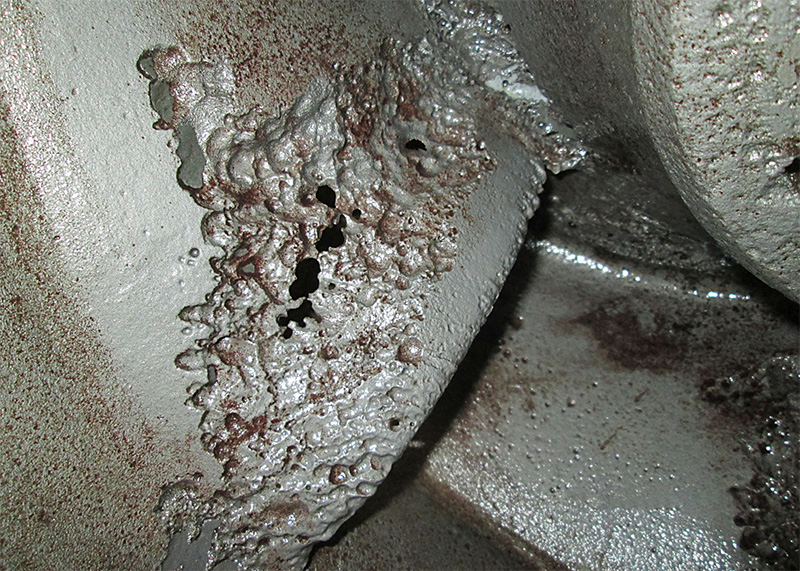 Pump impeller affected by cavitation. Pump impeller affected by cavitation. |
- Noise: Often described as sounding like gravel or marbles passing through the pump casing.
- Vibration: Cavitation causes intense vibration, which may damage bearings, seals and shafts.
- Reduced Performance: You may observe a drop in flow rate, discharge pressure or head, and increased power draw under unstable conditions.
- Physical Damage: Persistent cavitation can lead to pitting, chipping or erosion of impellers and casings.
- Debris in Discharge: In extreme cases, fragments from worn components such as seals or bearings may appear in the pumped fluid.
|
How to Prevent Cavitation
- Maintain Adequate NPSH Margin
Ensure that NPSHᴬ ≥ NPSHʳ + safety margin (commonly around 0.5 – 1 metre, sometimes up to 1.5 metres).
- Optimise Suction Conditions
Raise the fluid source level or lower the pump to increase static head.
Minimise suction line length, enlarge pipe diameter, and avoid sharp bends or restrictions.
Keep the strainer and filters clean to reduce friction losses.
- Manage Pump Speed
Reduce rotational speed when possible. This lowers NPSHʳ and helps maintain conditions above catalytic thresholds.
- Select Suitable Pump Size and Type
Choose pumps whose performance curves fit the application and maintain adequate NPSH conditions under all operating circumstances.
- Temperature Control
If fluid temperature is high, consider cooling or insulation to reduce vapour pressure and minimise cavitation risk.
- Regular Inspection and Maintenance
Monitor for unusual noise, vibration or performance drop. Early detection and correction, such as cleaning pipework or adjusting operation, can prevent long-term damage.
Summary Table
Insufficient NPSH
Increase NPSHA or reduce NPSHr, maintain a safety margin
Poor inlet design
Shorten suction pipes, use smooth bends, enlarge pipe diameter and keep strainers clean
High speed
Reduce pump speed where possible to lower NPSHr
Wrong pump selection
Match the pump to the system and operating range, choose a model that meets NPSH requirements
High temperature
Monitor and control fluid temperature, cool or insulate where appropriate to reduce vapour pressure
Maintenance
Inspect regularly for noise, vibration and performance loss; clean pipework and address issues early
Final Thoughts
Cavitation is a serious but preventable issue when addressed from the design stage through operation and maintenance. At TF Pumps, we help ensure your system is correctly specified and optimised to avoid cavitation risks and maintain long-term reliability.
Additional Reading
How Do Centrifugal Pumps Work?
Friction Loss – What is it and how do I calculate it?
British Pump Manufacturers Association (BPMA): Cavitation Resources
Understanding Axial, Radial and Mixed flow Types