Industry
Centrifugal pumps play a critical role in numerous industrial and commercial applications, designed to move fluids through a system efficiently. At the heart of these pumps lies the impeller, a rotating part for converting the kinetic energy of mechanical motion into hydraulic energy, driving fluid movement. In this blog, we will explore what impellers are, their significance in centrifugal pumps, and the different types available to suit various operational needs.
Impellers are the main component of a centrifugal pump, and are typically made from metals or durable plastics. They are shaped with either blades or vanes to facilitate the flow of fluids. Impellers rotate within a casing, drawing fluid into the pump and expelling it at a higher pressure.
They have multiple different designs, which directly affects the pump’s efficiency, capacity, and performance in various applications, from irrigation systems to chemical processing. By understanding the different types of impellers and their specific applications, engineers can choose the most suitable option for their requirements, ensuring optimal performance and longevity of the pump system.
Below we will discuss 6 of the different types of impellers used in centrifugal pump. Each of these designs are tailored for specific needs and applications:
Open impellers consist of vanes or blades fixed to a central hub without a back cover. Their central hub is usually mounted directly on to the pump’s shaft. Open Impellers (as the name suggests), are completely open and have no walls or support surrounding them. This design allows for easy passage of larger solids through the pump, making them suitable for handling slurries and wastewater. It also makes them easier to clean and repair.
However, open impellers are weaker than other impellers due to their lack of support / walls. They are also the least efficient impeller as they require more Net Positive Suction Head (NSPH) than other impellers. Due to this, you will usually find open impellers installed into smaller pumps, where efficiency is not as important.

Closed impellers have walls / shrouds at both the front and back of the blades, providing a stronger structure. This design allows them to maintain higher efficiency levels, making closed impellers the most popular choice for larger centrifugal pumps. They work exceptionally well in clean water applications, such as water supply systems, where there’s no solids.
One of the key advantages of closed impellers is their high operational efficiency and lower Net Positive Suction Head (NPSH) requirements. This means they can effectively move fluids more efficiently than any other type of impeller. The downside to closed impellers is their inability to handle solids. They are easily clogged and difficult to clean, due to their enclosed casing.
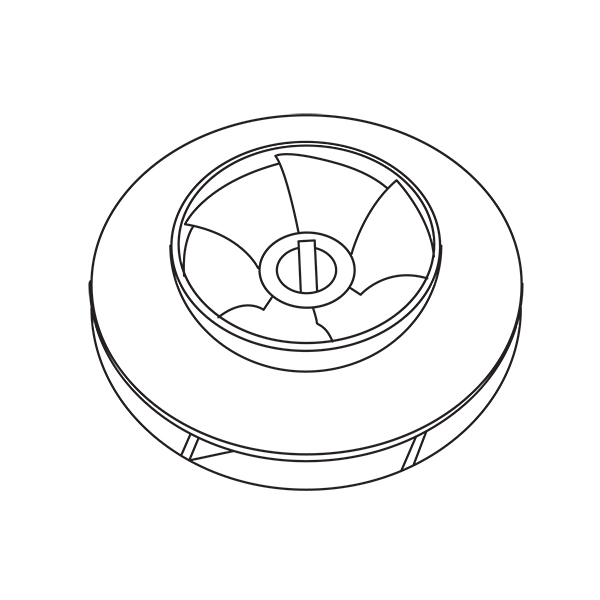
The Semi-Open Impeller serves as a bridge between open and closed impeller designs, featuring one shroud or wall at the back of the vanes. This singular shroud provides additional strength to the impeller while boosting operational efficiency compared to open impellers. The design allows for the handling of moderately sized solids, making them versatile in various applications. Because the semi-open structure is not fully enclosed, these impellers retain the advantage of easy cleaning.
Semi-open impellers find their primary use in industries that deal with small solids or higher viscosity liquids. Common applications include wastewater treatment facilities, where the ability to manage solids is crucial, as well as the pulp and paper industry and chemical processing plants. Their balanced approach to efficiency and solid handling makes them an ideal choice for these demanding environments. They provide reliable performance while still being user-friendly in terms of maintenance.

Vortex impellers share a visual resemblance with open impellers but their blades are shaped like a vortex. This design allows them to generate a swirling mass of water, creating a whirlpool effect. This whirlpool effect effectively keeps solids away from the impeller, preventing the internal components from potential damage. This design makes vortex impellers particularly effective for handling solids, as they can accommodate particles up to the size of their inlet diameter.
Despite their strengths, vortex impellers are not as efficient as other types of impellers; so, they are typically reserved for specialised applications. They are mostly used in sewage systems and other applications where the liquid contains solids or debris.

Cutter impellers are also similar in appearance to open impellers, with a wall / shroud at the base of the blades. However, their vanes are developed with sharp edges, this design allows them to grind soft solids before they enter the pump. Like vortex impellers, they are also low efficiency but are ideal for specialist applications.
Their design enables them to efficiently shred soft solids such as sanitary products, rags, and sludge, making them suitable in wastewater treatment processes. These impellers are also utilised in the agricultural sector for managing wastewater that includes animal waste, straw, and zoological waste. They are also widely used for wastewater from many different industries such shopping centres, hospitals, hotels, slaughterhouses, and many more.
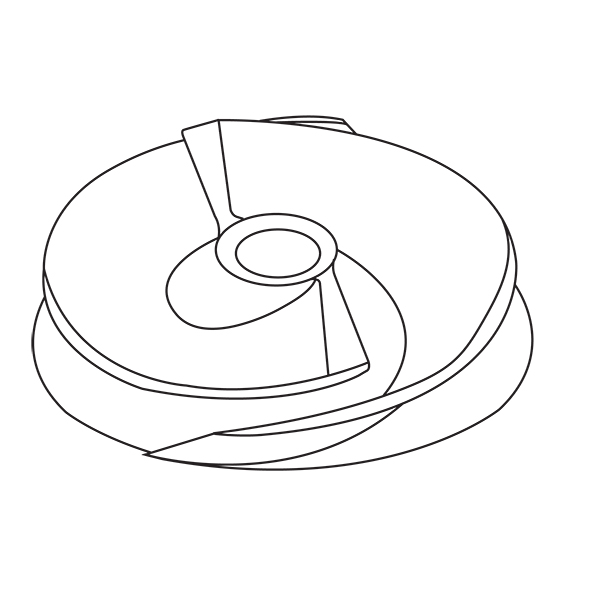
The least common impeller. They work in a similar fashion to positive displacement pumps, and the liquid is drawn into the pump by the screwing motion, creating a vacuum to draw the fluid out of the discharge. They provide a smooth, fast flow, with high head and minimal shear.
Spiral or screw impellers are among the least commonly used types of impellers, operating similarly to positive displacement pumps. Their distinctive design utilises a screwing motion that creates a vacuum inside of the pump, which draws the fluid out to the discharge side. This mechanism results in a smooth flow with minimal shear, making them highly suitable for applications that require careful handling of liquids.
While spiral impellers offer high head and flow rates, they come with a higher price tag compared to other impeller types. However, their ability to manage viscous or shear-sensitive products makes them a valuable choice in specialised applications.

In conclusion, the choice of impeller design significantly influences the performance and efficiency of centrifugal pumps. By familiarising themselves with the various types of impellers, engineers and operators can make informed decisions tailored to their specific applications. Implementing the right impeller type not only enhances fluid movement but also boosts productivity and lowers operational costs. This understanding underscores the impeller’s vital importance as a fundamental component within contemporary pumping systems.
Fill in the form below and one of our friendly advisors will contact you.