Industry
In any fluid system, efficiency is key, and maintaining a constant flow is crucial to ensuring smooth operation while minimising energy costs. However, one often overlooked factor that affects flow is friction loss. Friction loss occurs naturally as fluid moves against the pipe walls. While it may seem minor at first, its gradual impact on system performance and operating costs can become significant over time.
In this blog, we’ll dive into what friction loss is, why it’s important to account for it in your system design, and how to calculate it to optimise efficiency.
If you need additional help, please contact our team.
Friction Loss is an important factor to consider because it has a direct impact on your performance. It reduces pressure, so more energy is needed to maintain flow. This leads to increased power consumption and decreases system efficiency. As friction increases, pumps will be forced to work harder, meaning they will wear out faster.
Several key factors influence the amount of friction loss in a piping system, each of which plays a role in determining how efficiently fluid moves through the network.
To calculate it effectively, it’s essential to understand the methods engineers and technicians use to assess the resistance fluid encounters as it moves through pipes. Two popular methods for calculating friction loss are the Darcy-Weisbach Equation and the Hazen-Williams Formula. The Darcy-Weisbach Equation offers a comprehensive analysis applicable to various fluids and pipe configurations. In contrast, the Hazen-Williams Formula simplifies calculations, focusing specifically on water flow characteristics in piping systems. Understanding these methods will enhance your ability to manage fluid flow effectively and improve system reliability.
The Darcy-Weisbach Equation calculates friction in fluid flow within pipes by considering fluid density, flow velocity, pipe diameter, and friction factor. This versatile formula applies to various fluids and pipe configurations.

Read More About Darcy-Weisbach Equation
The Hazen-Williams Formula is a more simplified method for calculating friction loss in water flow through pipes. It uses the flow rate and pipe diameter to determine pressure loss, making it particularly effective for water distribution systems.

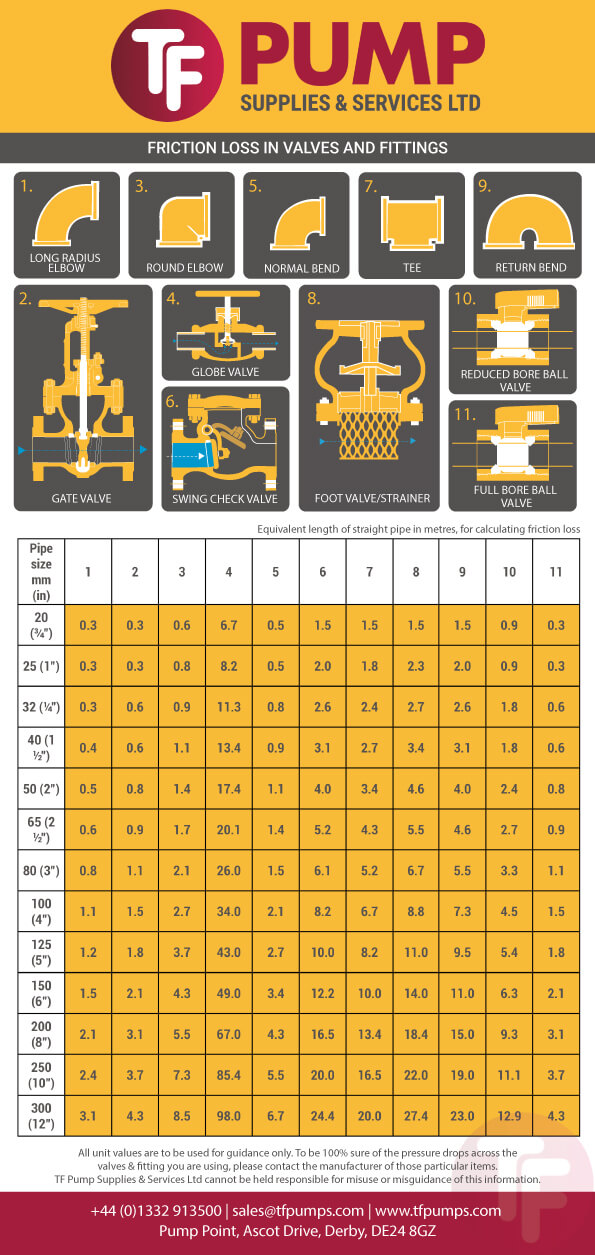
When there are valves and fittings within the pipework, additional calculations need to be made to get an accurate friction loss figure. We have created a table below to help you calculate this, including the most common types of valves and fittings.
Now that you’ve have your calculations, it’s time to explore effective strategies to reduce it and enhance overall efficiency. By implementing targeted approaches, you can minimise energy consumption and improve flow rates, ultimately leading to a more reliable system. In this section, we will discuss four key methods: optimising pipe sizing, selecting appropriate materials, minimising bends and fittings, and ensuring proper pump selection. These strategies will help you create a more efficient fluid system, reducing friction loss and extending the lifespan of your equipment.
Increasing the pipe diameter is one of the most effective ways to reduce friction loss. A larger diameter allows for smoother fluid flow, decreasing velocity and resistance.
Choosing smoother materials, such as plastic or polished stainless steel, can significantly lower friction compared to rougher options, like cast iron.
Designing a layout with fewer bends and fittings reduces turbulence and resistance. When bends are necessary, use gentle curves to maintain fluid flow.
Select a pump that is properly sized for your application to efficiently overcome friction loss. Consider flow rate requirements and the fluid characteristics to ensure optimal performance.
Understanding and managing friction loss in piping systems is crucial for optimising performance and reducing operational costs. By recognising the factors that contribute and implementing practical strategies—such as proper pipe sizing, material selection, minimising bends and fittings, and choosing the right pump—you can enhance system efficiency and longevity. Whether you’re designing a new system or maintaining an existing one, accounting for friction loss will lead to better energy usage and improved fluid flow. Prioritising these considerations not only benefits your operations but also contributes to more sustainable practices in fluid transport
Fill in the form below and one of our friendly advisors will contact you.