Industry
If you’ve ever set up a pump above a tank or drum, you might have come across the term suction lift. But what does it really mean, and why does it matter for your pumping system?
Suction lift occurs when a pump must pull fluid from a source that sits below its inlet. Unlike pumps placed directly in the liquid, the pump creates a partial vacuum in the suction line. This vacuum allows atmospheric pressure to push the fluid up into the pump. In practical terms: if your pump sits on a platform above a tank, it uses suction lift to draw the liquid upward.
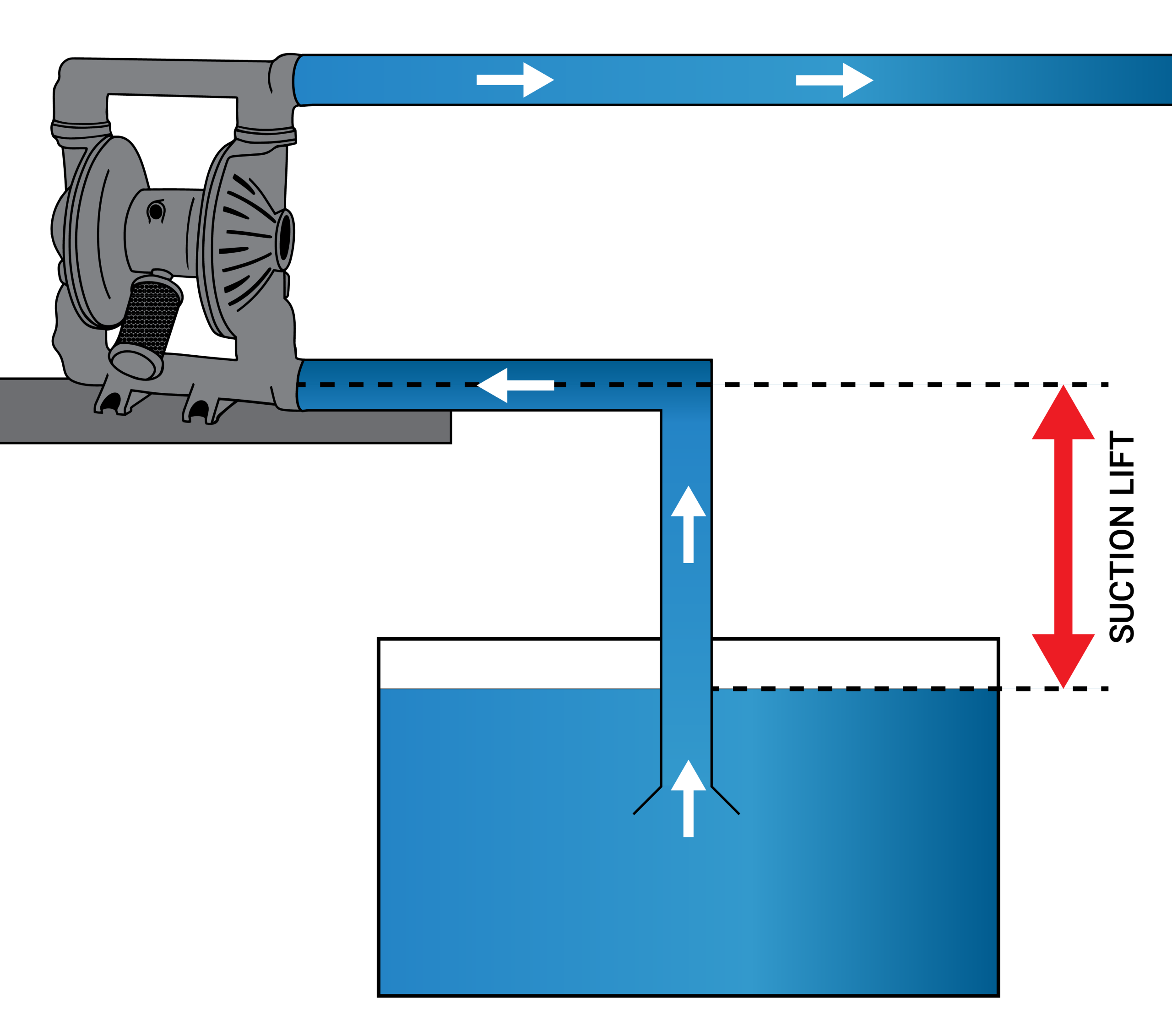
Important: Pumps installed inside the fluid (like submersibles) or with a flooded inlet do not require suction lift. It only matters when the pump is above the liquid level.
Understanding suction lift is essential for several reasons:
At sea level, the theoretical maximum suction lift for water is about 10.3 metres. This value comes from the maximum atmospheric pressure pushing on the liquid surface. In reality, pumps usually operate safely at lower lifts, typically around 6–8 metres, due to:
Note: At higher altitudes, lower atmospheric pressure reduces the practical suction lift further.
Different pumps handle suction lift differently:
Imagine pumping water from a 2-metre-deep drum to a hose 1 metre above. An AODD pump can handle this easily because it self-primes and draws fluid reliably. A centrifugal pump would require careful priming, airtight suction lines, and possibly reduced flow to avoid losing suction.
Suction lift reduces the pressure at the pump inlet, called Net Positive Suction Head Available (NPSHa). NPSHa is the “pressure margin” the pump has to operate safely without cavitation. If NPSHa falls below the pump’s required minimum (NPSHr), cavitation can occur, leading to noise, vibration, and potential damage. Friction losses in the suction line (from long pipes, elbows, valves, or strainers) also reduce NPSHa, but suction lift typically has the largest effect.
NPSHa = Atmospheric Pressure + Static Suction Head (or – Suction Lift) – Vapour Pressure – Suction Line Friction Losses
Note: All terms should be expressed in the same units, typically metres (m) or feet (ft) of liquid.
Atmospheric Pressure: converted to liquid head
Static Head / Suction Lift: positive if the pump is below the liquid, negative if above
Vapour Pressure: converted to liquid head
Friction Losses: head loss along suction piping
Keeping suction lift as low as possible, and designing straight, smooth suction lines, helps maintain NPSHa above the pump’s minimum requirement, ensuring reliable operation and avoiding cavitation.
Suction lift allows pumps to operate above the fluid source, offering flexibility and convenience. Knowing the limits ensures reliable, efficient pumping while protecting your equipment. Only pumps that need to pull fluid from below have to consider suction lift, submersible and flooded-inlet pumps are unaffected. By understanding pump type, fluid characteristics, and proper piping design, you can plan for it safely and effectively, avoiding common problems like cavitation, air leaks, and running dry.
Fill in the form below and one of our friendly advisors will contact you.