Industry
Every pump with a rotating shaft has the same weak point. The shaft has to get through the casing to reach the impeller, and where it does, a mechanical seal is holding the liquid in. Seals are consumables. They wear, and eventually they weep. On water that is a mopping-up job. On sulphuric acid or a solvent it is something else entirely. A magnetic drive pump does away with the shaft penetration altogether, and the leak path goes with it. This guide covers how a magnetic drive pump works, what sits inside one, how it stacks up against sealed and canned motor designs, and the duties where it is genuinely the right call. For further information or specific questions, please contact us on +44 1332 913500.
A magnetic drive pump is a sealless pump. Torque gets from the motor to the impeller through a magnetic coupling instead of a shaft, so nothing crosses the casing wall. You will see the same thing called a mag drive pump, a magnet drive pump or a magnetically coupled pump depending on who is writing the datasheet. Most are centrifugal, though regenerative turbine and positive displacement versions are made too.
The pumped liquid stays sealed inside the hydraulic section from start to finish. There is no dynamic seal, so there is nothing to wear out and nothing to leak. That is why you find these pumps on acids, solvents, plating chemistry and anything where a leak becomes a safety or compliance problem rather than a nuisance.
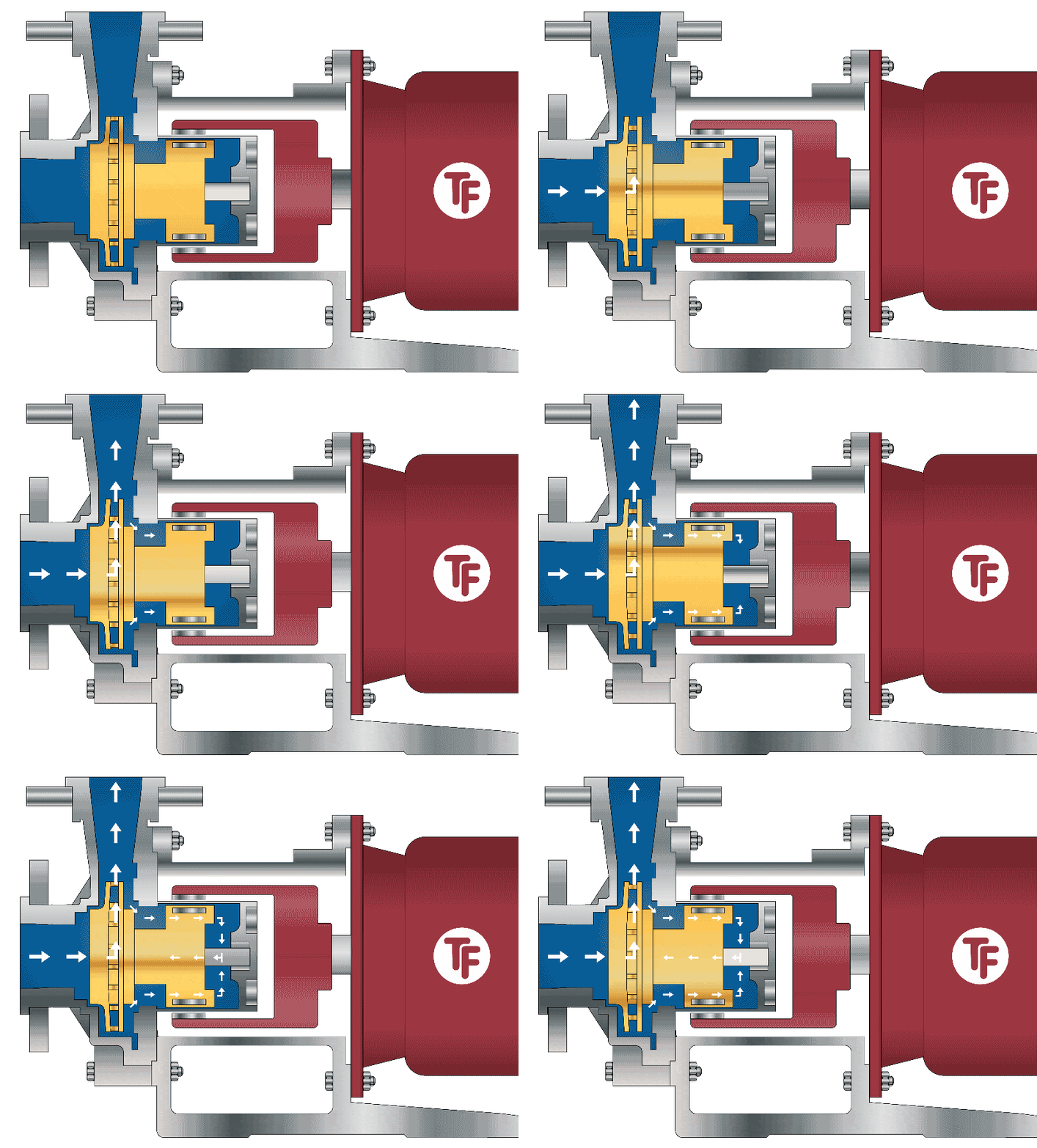
The animation above shows the coupling turning. There are two magnet assemblies and a sealed barrier sitting between them that the liquid never crosses.
On the motor shaft sits an outer drive assembly, usually a bell or a ring carrying permanent magnets. It lives entirely outside the pump casing and never sees the pumped liquid. Because torque is passed magnetically rather than through a coupling, most designs are close-coupled and need no motor to pump alignment at installation.
Inside the outer assembly sits the rear casing, also known as the containment shell or can. It is a closed cup that closes onto the pump head and keeps the two magnet sets apart. A permanent magnet field passes straight through it, which is the whole trick: the rear casing can be solid and unbroken, with no opening for anything to escape through.
On the wet side, a second magnet assembly is bonded to the impeller and carried on what is usually a stationary shaft. Its poles lock onto the poles of the outer assembly through the rear casing. Turn the outer assembly and the inner one turns in step with it, taking the impeller with it. After that the pump behaves like any other centrifugal pump, flinging liquid outwards from the impeller eye into the casing and away to the discharge.
The inner assembly runs on plain bearings, typically silicon carbide, alumina ceramic or filled PTFE, and the pumped liquid is what lubricates and cools them. A small share of the flow is recirculated through the rear casing to carry heat away. This is worth remembering, because it is the reason a magnetic drive pump must never be started or left running dry.
Industrial mag drive pumps almost all use a synchronous coupling, meaning both magnet sets are permanent magnets and turn at the same speed with no slip. Rare earth magnets, usually neodymium iron boron, pack a lot of torque into a small assembly.
Rear casing material is then the decision that shapes everything else. Non-metallic rear casings in polypropylene, PVDF or similar thermoplastics are chemically resistant, cheap to mould and, being non-conductive, generate no eddy currents at all. Metallic rear casings in stainless steel or Hastelloy take higher pressures and temperatures, but a rotating magnetic field induces eddy currents in anything conductive. Those currents put heat into the containment area and eat a slice of the motor power, so pumps with a metal rear casing need more thought given to the cooling flow and to how much temperature headroom the liquid actually has.
A conventional centrifugal pump uses a rotating face seal where the shaft passes through the casing. There is nothing wrong with that on straightforward duties. The catch is that the seal is a wearing part, and on hazardous liquids one seal is rarely enough: you end up specifying a double seal with a barrier fluid system, a seal pot and the monitoring that goes with them. A mag drive pump removes all of it.
Canned motor pumps are the other sealless family. Rather than a magnetic coupling, the motor rotor runs inside the pumped liquid behind a thin stator liner, so the pump and motor are one unit. They are compact and give you a second containment boundary, but the motor is not something you can buy off a shelf, and changing the duty point usually means changing the pump. A magnetic drive pump runs on a standard IEC motor, so it can be repowered, put on an inverter or rewound locally.
No dynamic seal means no route for liquid or vapour to get out. On volatile chemicals that also puts fugitive emissions under control at the pump rather than leaving them to be managed further down the line.
Take out the mechanical seal and you take out the seal support systems with it: no barrier fluid to top up, no flush lines to plumb, no seal pot to monitor.
The sealed hydraulic section keeps the atmosphere and any seal debris out of the liquid, which is why mag drive pumps are the default in pharmaceutical, semiconductor and high-purity water work.
Wetted parts get specified to the liquid rather than the other way round. Polypropylene handles a lot of everyday chemistry such as caustic soda, phosphoric acid and ammonia. PVDF goes further on aggressive acids like sulphuric and hydrofluoric, and on sodium hypochlorite. Stainless steel suits solvents, fuels and oils, and Hastelloy is there for the liquids that defeat 316.
With no shaft coupling between motor and pump there is no alignment to set or check, which removes a common source of vibration and early bearing wear on close-coupled units.
The pump costs more to buy. Against that, put no seal replacements, no seal support hardware, no product lost through a weeping seal, no clean-up and far less unplanned downtime. On an expensive or hazardous liquid that argument tends to settle itself fairly quickly.
No pump suits every duty, and mag drive pumps are fussier than most. They want clean liquid. Solids and abrasive particles go straight through the internal bearings and can score the rear casing, and GemmeCotti’s own guidance on their HTM range is that once you are past roughly 2% solids you are better served by a mechanically sealed pump. They must not run dry either, because the liquid is doing the lubricating and cooling, so build in dry-run protection with a level or flow switch that stops the pump when it loses liquid.
The coupling can only transmit so much torque. If the system demands more than that, the two magnet sets fall out of step and decouple. At that point flow stops and the pump heats up quickly. Viscosity, specific gravity and head all draw on the same torque budget, so sizing has to cover the coupling as well as the hydraulics. Thermoplastic pumps in particular are not built for thick liquids: the GemmeCotti HTT, for example, is rated to 45 centipoise. Most magnetic drive pumps are not self-priming as standard, so plan for a flooded suction or choose a self-priming design such as the GemmeCotti HTM SP, which can lift from up to 6 metres. And heat weakens permanent magnets over time, which is why the maximum liquid temperature on the datasheet should be treated as a limit rather than a target.
Mag drive pumps show up wherever containment matters more than anything else on the spec. Typical duties include:
We supply magnetic drive pumps from GemmeCotti and Flojet, covering heavy chemical process duty down to compact pumps that live inside processing equipment. These are the ranges we specify most often:
 |
GemmeCotti HTM The workhorse of the range and the one we quote most. A non-metallic centrifugal pump in polypropylene or PVDF covering 0.5 to 130 m³/h and heads to 48 metres, built for acids, solvents and other corrosive or hazardous liquids. AISI 316 versions are available where the chemistry calls for steel. |
 |
GemmeCotti HTT A regenerative turbine design for smaller flows that still need pressure, up to 9 m³/h and 48 metres of head. Its real advantage is tolerance of up to 20% entrained gas, so it keeps pumping on tank emptying and solvent duties where a centrifugal would lose its prime. |
 |
Flojet NEMP Series Entirely non-metallic thermoplastic construction for aggressive chemicals, acids, alkalis and pure or chilled fluids. Multistage options cover the duties that need more pressure than flow, and the IPX5 motor housing copes with a wet environment. |
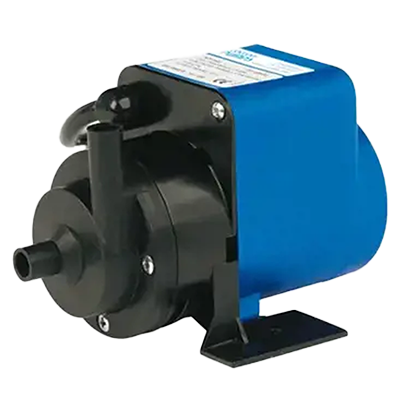 |
Flojet NDP Series The compact option for continuous transfer and recirculation of chemicals, chilled water and high-value liquids. Polypropylene housing, encapsulated magnet and alumina ceramic spindle, in a footprint small enough to build into a machine. |
Key benefits: No shaft seal and no leak path • No seal support systems to maintain • Materials matched to the chemical • No motor to pump alignment • Lower lifetime cost on hazardous or high-value liquids
Not sure which materials suit your liquid? Our chemical compatibility calculator is a sensible first check, and we will confirm the coupling has the torque for your duty before anything is quoted.
A few components make the difference between a mag drive pump that runs for years and one that comes back to us:
We’re here to answer your questions and help you find the right magnetic drive pump for your application.
Fill in the form below and one of our friendly advisors will contact you.

